Sven Sauer (DE) – Deviation
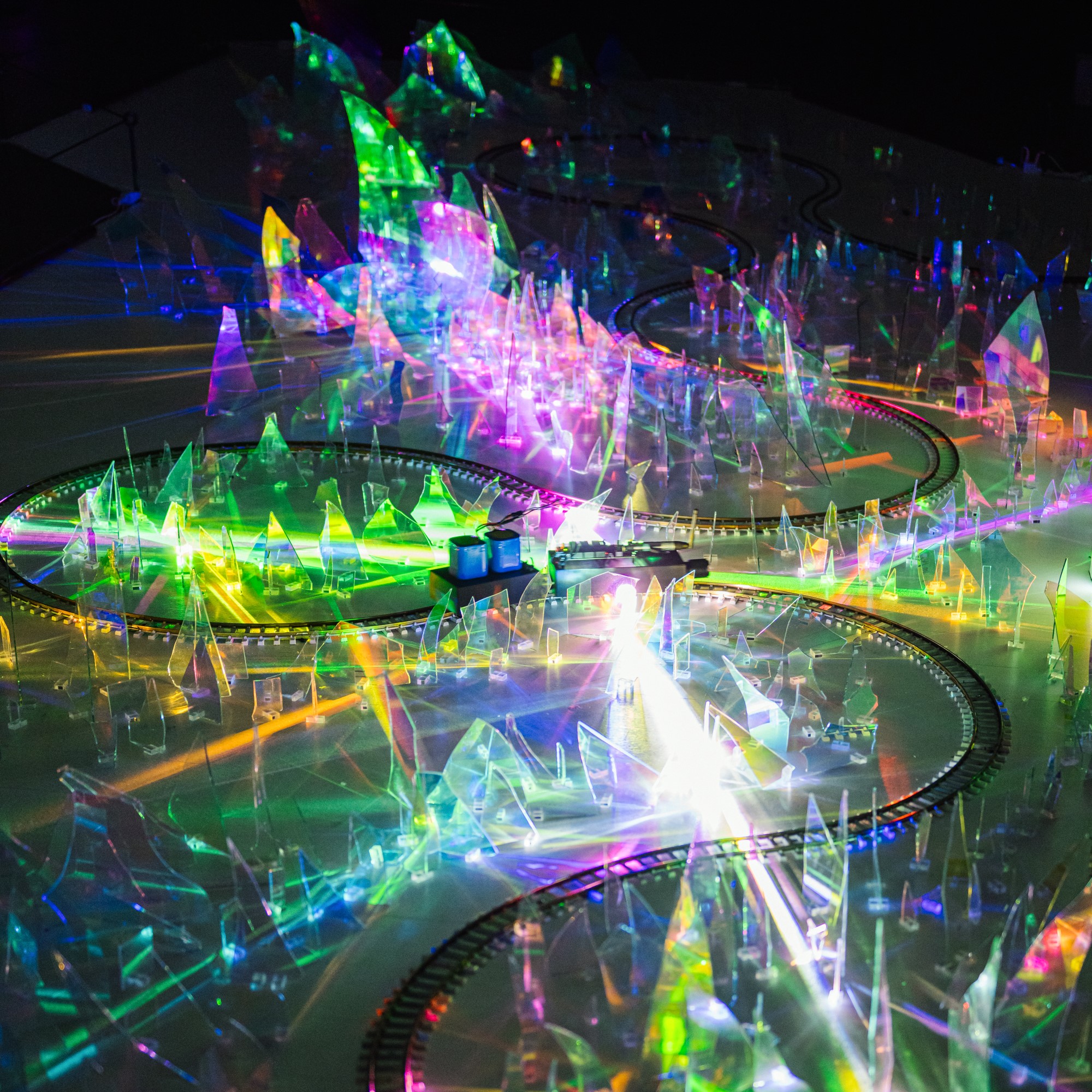
- Location: LNMA Radvila Palace Museum of Art, Vilniaus St. 24
- Country: Germany
- Soundtrack: Theatre Of Delays
- Photo: Carsten Beier
- Duration: 6 min
- Train Modification: Helldorfer Engineering
- Electronics: Lukas Esser
- Creative Coding: Markus Graf
- Production: Sevval Gür & Martin Hussain
- Text & Studies: Rutger Bregman
- Working hours: 11:00–23:00
In October 1939, Hitler ordered his generals: „The ruthless use of the Luftwaffe to break the British will to resist.“ Experts warned of panic and violence. They predicted that in such exceptional situations, humans would „descend several steps on the ladder of civilization.“ „The city will slip into total chaos.“
On September 7, 1940, German planes reached London. Over 80,000 bombs fell in nine months, and a third of the city was destroyed. However, instead of chaos, the Canadian psychiatrist Dr. John MacCurdy observed: „Children continued to play, customers haggled, and police officers nonchalantly directed traffic.“ Solidarity outweighed fear. People later recalled a time of unity, „when everyone helped each other, and it didn‘t matter whether you were left-wing or right-wing, poor or rich.“ The attack was horrific – but it brought people together. The British will to resist was not broken. Despite these findings, the Royal Air Force insisted on responding to the attacks with counterattacks. During these bombings, ten times as many people died as on September 7. However, in Germany, mass panic also failed to materialize. People reported a strong sense of social cohesion: they came together and stood up for one another.
After the war, U.S. economists examined the effects of the bombings. The main question was: Should the army have used this type of warfare more frequently? The answer surprised everyone: The bombings had been a fiasco. The German war economy was even strengthened, possibly prolonging the war. An American economist wrote: „We began to realize that we had encountered one of the greatest misjudgments of the entire war.“
When we receive reports about war or disasters, humanity is usually not portrayed in a positive light. But data, studies, and eyewitness accounts show that human nature is not as dark as it is often depicted. The installation raises the question of whether our perception of civilization and chaos is a profound misjudgment.
The installation consists of broken glass collected from all over the world and sent to Berlin. The data in the text was compiled by historian Rutger Bregman.
LOCATION PARTNER: